Tag: ADHD

Well… It’s all about ADHD at the end of the day 🙂


  • ADHD Latest Research and News | Ed. 24/01

    Why are so many adults just now being diagnosed with ADHD?

    Rates of adult ADHD have jumped in the last two decades. Researchers are exploring whether 24/7 use of technology may be contributing.

    Full story at the National Geographic

    ADHD in Adults: Does Age at Diagnosis Matter?

    Hutt Vater C, DiSalvo M, Ehrlich A, Parker H, O’Connor H, Faraone SV, Biederman

    J.J Atten Disord. 2024 Jan 2:10870547231218450. doi: 10.1177/10870547231218450. Online ahead of print.

    Mind Wandering & Rumination

    Excessive mind wandering, rumination, and mindfulness mediate the relationship between ADHD symptoms and anxiety and depression in adults with ADHD.

    Kandeğer A, Odabaş Ünal Ş, Ergün MT, Yavuz Ataşlar E.

    Clin Psychol Psychother. 2023 Dec 5. doi: 10.1002/cpp.2940. Online ahead of print.

    Decision Making

    Neurobiological basis of reinforcement-based decision making in adults with ADHD treated with lisdexamfetamine dimesylate: Preliminary findings and implications for mechanisms influencing clinical improvement.

    Newcorn JH, Ivanov I, Krone B, Li X, Duhoux S, White S, Schulz KP, Bédard AV, Pedraza J, Adler L, Blair RJ.

    J Psychiatr Res. 2023 Dec 3;170:19-26. doi: 10.1016/j.jpsychires.2023.11.037. Online ahead of print.PMID: 38101205

    Wiring

    Free article

    Abnormal wiring of the structural connectome in adults with ADHD.

    Tolonen T, Roine T, Alho K, Leppämäki S, Tani P, Koski A, Laine M, Salmi J.

    Netw Neurosci. 2023 Dec 22;7(4):1302-1325. doi: 10.1162/netn_a_00326. eCollection 2023.

    ad slot

    Comorbidities

    Autism

    Supporting adults with autism – don’t forget comorbid ADHD.

    Leaver L, Cubbin S, Parry A.Br J

    Gen Pract. 2023 Nov 30;73(737):540-541. doi: 10.3399/bjgp23X735633. Print 2023 Dec.

    ad slot

    Chronic Pain & Elderly

    Beware of attention-deficit/hyperactivity disorder (ADHD) in older adults.

    Nagamine T.Psychogeriatrics. 2024 Jan;24(1):148-149. doi: 10.1111/psyg.13048. Epub 2023 Nov 15.

    Pharmacotherapy

    Comparing Pharmacotherapies for ADHD in Adults: Evidence From Outcome-Focused Analysis of Food and Drug Administration Drug Label Registration Trials.

    Surman CBH, Walsh DM, Bond JB.

    J Atten Disord. 2024 Jan 16:10870547231218041. doi: 10.1177/10870547231218041. Online ahead of print.

    A Single-Blind, Placebo Controlled Trial of Triple Beaded Mixed Amphetamine Salts in DSM-5 Adults With ADHD Assessing Effects Throughout the Day.

    Adler LA, Anbarasan D, Sardoff T, Leon T, Gallagher R, Massimi CA, Faraone SV.

    J Atten Disord. 2024 Jan 12:10870547231222260. doi: 10.1177/10870547231222260. Online ahead of print.

  • What Is The Best Font for ADHD?

    What Is The Best Font for ADHD?

    In 2020, I published ADHD and the Use of Sans Fonts: Do They Make a Real Impact on Legibility? Since then, it’s become one of the most-read posts on this blog — which tells me that many hyper-neurodivergents are indeed wondering which is the best font for ADHD.

    I also believe that the original article may be too technical, so here’s an ADHD-friendly version of it, along with a few reflections and a cool note on a font designed for dyslexics.

    Please note: this discussion is about trying to read something we’re interested in — but just can’t. For a deeper understanding, check out the original post first.

    What are the Styles of Fonts?

    For the purpose of this discussion, I focused on two: the “Serif” fonts (those with curly ends) and the “Sans” fonts (those without).

    Is There a Best Font for ADHD?

    To this date, there’s no research confirming the existence of an ADHD-friendly font, or whether the use of certain fonts could help neurodivergents at all.

    However:

    1. I made my case that sans fonts are the most ADHD-friendly, based on my own experience, Dr. K’s, and an article published by McKnight (2010).
    2. I recently discovered a new font created for dyslexics (who are also neurodivergent).
    3. And the fact that so many people Google “ADHD fonts” and end up here — well, that says a lot.

    Why “Sans” is the Best Font Style for ADHD?

    Previously, I mentioned a subjective reason: for me (and Dr. K, who is also ADHD), sans fonts are clearer. Now I’d like to explain why. 

    Is This Impulsivity?

    Basically, text written in a serif font (like Times New Roman) looks like a blur of words my brain can’t distinguish:

    • A paragraph feels like a single block of words, so
    • keywords don’t pop out at first sight, and
    • I feel a rush to move on to the next paragraph.

    A copy not written in sans fonts — even when I’m interested in it — doesn’t help me read word by word. I get eager to move forward, and I end up reading nothing.

    Is This Distractibility?

    Here’s another funny thing that might sound silly: as a blogger and web designer, I love serif fonts. As a writer, they make me feel more “writerly.” So here’s what happens:

    Sometimes, when I’m reading The New Yorker’s website — which has the most beautiful serif font — I start wondering if “maybe now I could use it.” I then spend a good amount of time searching for a free look-alike version, only to try it and think, “You’ve procrastinated again.” 🤦🏻‍♀️

    How to Choose an ADHD Friendly Font? Procrastination Alert

    Edit by Laly York

    When searching for a font for ADHD, we can easily end up procrastinating — looking for the prettiest, most popular, or most recommended. Been there, done that.

    “Reading is your goal.” Keep that in mind.
    A humble suggestion:

    1. Start with Open Sans.
    2. Stick with it for at least a few days.
    3. If you’re still struggling, try another one.

    Also remember that font size and line spacing (or “line height” on websites) matter.

    In Microsoft Word, I use size 12 with multiple line spacing set to 1.7 (1.5 isn’t enough — and it makes a huge difference for me). I also write with the zoom at 170% to avoid using my glasses. 🤷🏻‍♀️

    Is There Something Written about the Use of Sans Fonts for ADHD?

    So far, I’ve only found guidelines for designing books for children.

    As I mentioned before: “When we’re kids, we start learning to write with block letters — which makes perfect sense: we learn the alphabet one letter at a time, and only then do we begin to put them together to create words.”

    One letter at a time is what my ADHD brain needs — and I realized this in law school (undiagnosed, by the way).

    Recently, I was surprised to learn that there are other neurodivergents who need exactly the same: those with dyslexia.

    Dyslexic Friendly Fonts and Its Relationship with ADHD Friendly Fonts

    For dyslexics, words themselves are the issue. Fortunately, there has been a lot of progress in the digital world to support them.(1) 

    One of the things that struck me the most was the development of a font designed specifically for their needs.

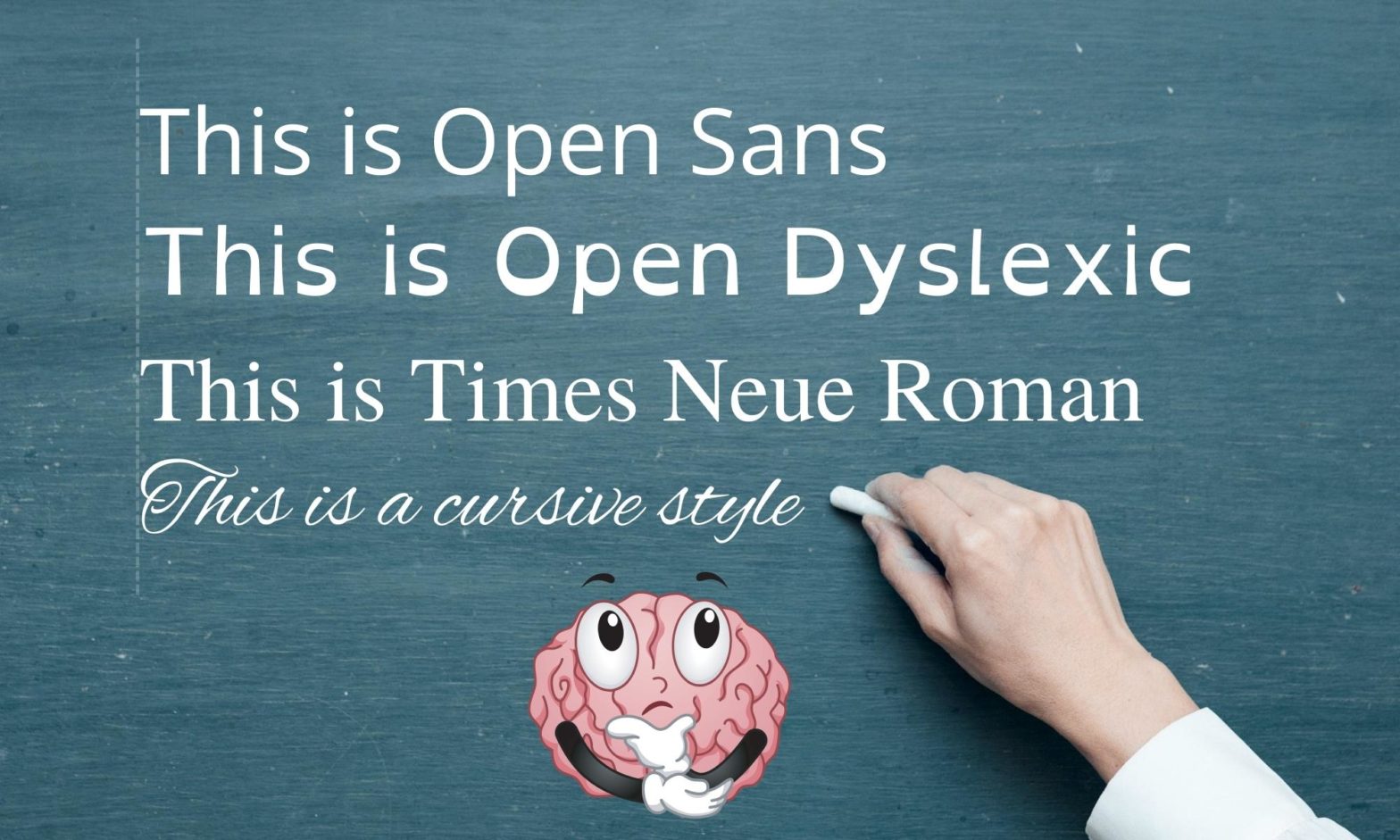
    As you can see in the image, “Open Dyslexic” (2) has letters that are:

    • wider (the x-axis is increased), which consequently increases the space between the letters, and
    • heavier at the bottom so that dyslexics don’t flip letters such as b and p.

    One letter a time… 

    How to Change the Font When We Cannot Change Them?

    If you’re reading from a website or book written in serif fonts and it’s giving you a headache, here are a couple of solutions:

    1. Reading from a website: Safari, for instance, lets you choose “Reader View.” This provides clean text displayed in a sans font.
    2. Reading from a book: I scan it, export it as a PDF, and use Adobe Acrobat Pro to change the font. Does it take forever? At first, yes — but I need to read.

    Wrapping It Up

    Since there’s no research on this topic yet, give sans fonts a try.
    Open Sans, by Google, is free to download and install. You might also want to try Roboto, which is thinner.
    If this works for you, please help me — help us — spread the word!

    Footnotes

    (1) In 2008 Dutch designer Christian Boer (who is dyslexic himself) designed the font “Dyslexie”. He presented it at a TED Talk in 2011.

    (2) The font “Open Dyslexic” was designed by Abelardo González and released as open source — meaning you can download it for free.

  • Do You Wanna Be an ADHD Coach: 7 Questions to Ask Yourself

    Do You Wanna Be an ADHD Coach: 7 Questions to Ask Yourself

    ADHD coaches seem to be becoming trending in our world. So, I got to wonder: Who wants to become and ADHD coach, and why? Do they know what it takes to become one and what they’d be getting into?

    My questions arise for three mains reasons:

    • one, because one of the most read posts at this blog is the one about my nightmare at ADDCA, which leads me to think there are many people seeking seriously how to prepare for this profession; 
    • two, because the ADHD world is quite vast and complex, and those ADHD coach training courses make it seem like becoming a coach can take you a couple of years.
    • Three, because the ADHD world is also quite sensitive and everything related to it seems to be becoming a business: ADHD coaches, journals; fidgeting toys; apps! … And it makes me fear about us.

    This is a special world; not a business opportunity nor a world we can fully comprehend with a few courses or books. Every hyper neurodivergent is different; there’s a lot to learn about neuroscience and psychology (for instance); our community is still unraveling what ADHD is [1], and … it’s a lot.

    good ADHD coach can help improving the life of a hyper neurodivergent; absolutely. But this person can also have a bad impact in our lives, leaving us frustrated and stuck in a loop of low-self-esteem and unproductively for days, weeks or more.

    Therefore, I thought I might help you with some questions; think about them as a roadmap to figure out if this is the career path you’re willing to take, and you’ll enjoy taking.

    1) Do You Know What an ADHD Coach Is and Does?

    When we seek for help, we usually have two or three persons in our team: 

    • A psychiatrist specialized in ADHD, who conducts the diagnosis and screening tests, and eventually provides for us medication if necessary and guides us through the process of finding the right one for us.
    • A CBT therapist specialized in ADHD (where CBT stands for cognitive behavioral therapist)
    • A therapist: because, in many cases, the symptoms of our ADHD may be getting in the middle of our success due unresolved issues from our past, or because we get overwhelmed by the issues in our present and we don’t know how to face them.

    With those people we have a doctor-patient relationship, and sometimes is not enough; sometimes we need “a push”, someone who can help us to “do stuff.” This person is an ADHD Coach.

    An ADHD coach, provides for a client guidance towards one goal, in a short term. [i] I like to think about an ADHD coach as a “Neuro Instructor,” because this person has the knowledge on how an ADHD brain works and also strategies to help us cope with our ADHD towards that one goal.

    Think about being the guide and cheerleader for a person who wants to do “one thing;” for instance: learn how to manage their time; commit to start or to finish a project; understand the impact of their ADHD on their behavior; etc.

    I dare to say that if your client wants eventually to continue working with you, endlessly, is because they need a CBT therapist instead or a therapist – plain and simple – to work on what may have been holding them back from thriving.

    2) Are You Hyper Neurodivergent Or Related to Someone Who Is?

    A person with ADHD, has a brain that works in a different way; we talk about  neurodiversity (which is not a medical term) for advocacy purposes, to put an emphasis on our necessity to be understood and heard. We are part of a whole wide world that is going to be very difficult to understand if you’re not ADHD or if you’re not directly related to someone who is (a relative, or someone you live with)

    Having control over our executive functions is our biggest challenge; time management, behavioral regulation, adjusting to the neurotypical rules, everything that a non-neurodivergent takes for granted is an exhausting battle in our world. 

    Amidst those battles and the tornado of thoughts within our hyperactive brain, for many of us it is very hard to shush all the noise so that we find our inner voice, the one that can tell us what to do, what’s better for us, how to take – what to others may seem – the simplest decisions.

    Bottom line is that there are insights about our lives that, if you’re not HN or directly related to someone who is, are going to take you a long time to unveil; this is simply what I’m saying. I am not pointing this out as condition to be a better ADHD coach. Ok? Ok.

    3) Have you done some serious research on what ADHD is?

    You may have seen social media threads with hyper neurodivergents saying, “That happens to me too! Are we clones?” You may have gone further and read articles on online magazines, and even a blog or two written by someone who has ADHD. Truth to be told, it often feels like we’re clones, but we are far from being equal. 

    To understand the HN world, consider the ADHD subtypes and their symptoms as variables you’ll need to analyze with others, such us: your client’s upbringing, education, support system, environment, etc. These other variables make a huge impact on how we manage our ADHD. What works for one client, could be unbearable for another one.

    If you’re coming from the neurotypical world, bear in mind that probably everything you might know about human behavior and think that might help us, it most certainly won’t. 

    My point is: this is such a special world, that I strongly suggest you to first learn as much as you can about it, before going on full “I’m gonna be coach” mode.

    4) Would you enjoy learning about neuroscience, psychology, pedagogy, constantly?

    ADHD is about science; ADHD is about training a brain that works in a different way. Motivational strategies, time management strategies, study techniques, pep talks and else, do not work for us as they do on neurotypicals. 

    You’ll need, for instance, the knowledge on the following fields:

    • Neuroscience, to understand how a brain works, and how an ADHD brain differs. 
    • psychology, to understand the behavior of a child, a teenager, an adult; and then, to understand how that behavior is affected by ADHD;
    • pedagogy, to help you come up with strategies!

    Am I saying “become an expert in those fields”? No. I am simply saying you’d need to have an educated comprehension on what ADHD is, with the help you can find in those fields. And, you’ll need to continue studying, because ADHD findings are in constant evolution.[2]

    You won’t be offering professional advice per se (medical nor psychological), unless you’re a doctor or a therapist of course; but still, you’d need to be up to date with the latest findings because we never know when one research could change the way we understand ADHD. This means putting your hands on the latest research; besides the fact that these are expensive, if you’re not familiar with reading these sort of papers you’ll be facing a long road.

    But please: do not feel discourage on this. It takes practice but it’s doable. Ok? Ok.

    5) How Would You Train to Become an ADHD Coach?

    As far as I’m concerned, most people take courses to get certified, and… that won’t guarantee you a proper education. If you’d ask me, I encourage you to become an “ADHD professional” instead.

    How to do that? Well, these are for instance the steps I took (and continue taking):

    1. Learning how a brain works and how an ADHD brain works (with books and researches on neuroscience, psychology, etc)
    2. Learning what are the main ADHD struggles (with books on coaching; blogs written by Hyper Neurodivergents; and hey, they are good researches on this as well)
    3. Come up with strategies to cope with those struggles (I do this from my personal experience and my background on education)

    There are great books, even some with a very friendly language, that will offer you information on all of the above, including coaching strategies.


    5. Who and Why Do You Want to Help As An ADHD Coach?

    Children, teenagers, adults? And, when you think about ADHD, do you think about ADD too? If you do so, choose one because there is a big difference. 

    An example: I decided to focus on adults and young adults in the search of new beginnings, such us new jobs, new college careers, for instance. Why? Mainly for two reasons:

    1) Because I was able to thrive without diagnosis nor treatment, and it breaks my heart to pieces to see how many hyper neurodivergents can’t find a true calling or can’t manage to finish the career path they’ve chosen;

    2) My experience on transiting the “University world” more than once, and my background on education have already given me plenty of tools to manage my ADHD to study, work and to be extremely organized.

    Who and Why. The less the better. By selecting this – let’s say – “path” for you, you are going to have a clear goal and you’ll be able to specialize on ADHD further, deeper. 😉

    7) Do You Feel a True Calling?

    The ADHD world is a wonderful and quite sensible one; you’ll feel you’re learning from us, more than once. We are very reliable people; we believe there is good in everyone, so we are going to believe in you. Thus, one line from your mouth, even with your best intentions, could go south and mess up with our minds big time.

    Are you willing to take that huge responsibility?

    As I said at the beginning, this is a special World; not a business opportunity. All things ADHD seem to be turning into a business; coaches, apps, journals, fidgeting toys; and many of us are so desperate to do something with our lives that are willing to get it all right now.

    Please, don’t take this path for the money. 

    We need ADHD coaches for their calling; we need them for their love, commitment, understanding and knowledge.

    Ask yourself, with your hand over your heart: Could you be the one for us?

    Pages: 1 2
  • ADHD Brain Freeze and Stagnation: Welcome to the S-Zone

    ADHD Brain Freeze and Stagnation: Welcome to the S-Zone

    Have you ever imagined the person you would hate to become? Have you ever feared it so much that thinking about it was your worst daymare? I have.

    Here it is: It is the end of the world (I shit you not) There are zombies eating brains in the streets; neurotypicals brains only; zombies are not stupid. I am in my sixties; I am a fat old lady, with long grey and messy hair, wearing an NYC hoodie I bought during the Big Bang and to which I held on to with the unbreakable hope of seeing the Big Apple one last time.

    My house – where I’ve been locked up since the zombies arrived – is falling apart. I had started to flip it before “the arrival”, but then, ADHD + zombies = “do cows sleep on their feet?” I live alone; I don’t want to rescue pets because everybody dies or leave, and I can’t handle any more pain.

    I survive. 

    That’s all I do. 

    Oh, my dildo still works.

    I am armed up to my teeth, and I do not ever open the door… But then one day, I see through my window a group of teenagers trying to escape the zombies, and I do; I open my door to them. I welcome them feeling they are disgustingly young and beautiful, while I’m watching how the blondie is about to get chopped by a booby trap I’ve forgotten to mention (oops) 

    They tell me they know about a place where one can build a safe future; they have been running towards it, and they won’t give up. And they want my truck; they saw I have gallons of gas, so they say to me, “let’s fill it up and go! Why didn’t you leave before?” My life flashes before my eyes, a tornado of thoughts hit me, and I can’t answer …

    The zombies break in and I feel one person must stay behind to fight them while the group gets in the truck… The sad truth is I’m too tired to even think about lifting my leg to jump into the truck. So I say, “You go.” And I die; only because I’ve put some of the blondie’s brain over my head; duh.

    But as I’m being eaten, I see them escaping towards their future and I feel envy… I think, “Why didn’t ‘I’ get out? Was I always so tired of surviving that I forgot how to live?” My life flashes before my eyes and my last thought is, “If only I…”

    Now, Seriously

    Years ago, I started writing that story just to vent, because my daymare is pretty much like that and I needed to do some catharsis. I have always feared to become that old lady who lives across the street and gets out from time to time; that one of whom people talk about saying, “They say she had a great future, and no one knows why she didn’t get through.”

    Why am I thinking about this today? Because a few weeks ago I entered – drum roll please – the stagnation zone. 

    That’s how I call it; when we get so burned out that we get stuck for days, weeks… even months if we don’t do something about it.

    How did I get here? Back in December I was juggling with a lot of projects, and a lot of things happened that stressed me out; I should have taken a break as I was taking care of those things, but I didn’t… When those things happened, I felt as if someone had thrown at me three more balls at once; and so eventually I ended up dropping them all, over my fucking my head.

    Living With ADHD and Entering the S-Zone

    You know… When I leave my house, I say to myself, “You’re leaving the house.” (Once again, “I shit you not.”) I can get so distracted in the streets, that my ex-husband used to say I’d die under a bus. 

    That being said, a couple of weeks ago I was crossing a street thinking, “Wait for the white light, the white little figure…” and out of nowhere it hit me: I am about to turn an age that FREAKS ME OUT.

    So right there in the middle of the street, I got to wonder, “What am I doing? What have I achieved? I have nothing. Can I still pull it off?” I felt a rush taking over me, and then I froze. I “dropped the balls,” but I did manage to get to the sidewalk. It’s not my ghost writing this post; chill.

    When I get those seriously negative thoughts, is when I know I have entered the S-Zone; so I refuse them immediately; I block them; I know it’s time to begin my rehab.

    Before my diagnosis, before knowing this was an ADHD thing, I use to fall in long periods of depression, ruminating about how shitty my life was when it wasn’t.

    Just To Be Clear…

    I was going to send a couple of newsletters with a series of posts, so you wouldn’t think I am not working for this blog. I also was afraid to show you how much I struggle because I want you to find strength in my stories…

    But then I wondered, “what if you find comfort in seeing how much I struggle too?”

    I was very doubtful about publishing this post; I didn’t want you to think, “And how about all that gratitude you’ve been practicing, and college, and blah? Was that a lie?” It wasn’t… It isn’t… I still do my thing every morning; I am still excited about coming back to a class; but I am just having “a few of those weeks.”

    When I enter the S-Zone, I can’t do much; I can’t do anything truly productive actually; so I fake a vacation… I decorate my house with a few things from NYC to make it look like a hotel, and I try – “I try” – not to work more than four hours per day, or not to work at all.

    And this is one of the reasons why I decided to post this: because I can stop working, but how about those of us who can’t? The stagnation is an ADHD thing, and I believe we should have the right to ask for a leave of absence at our jobs.

    How Does Stagnation Feels Like?

    The way I see it, this is like having car fueled by solar panels; when it runs out of energy it gets stuck. We could pull it for a few blocks with some help, but it’s not going to get further than that; and how exhausting would be to pull such a dead weight? How much it would hurt us to do so?

    It needs time to recharge, and we need to wait for the sun… Just wait…The more we pull, the longer is going to take us to recover. 

    Why am I still here if I know how to get out? Because after that day I realized I had entered the S-Zone, I didn’t slow down; I kept pulling and pushing… so now I’m paying for it. 

    How to Cope With the ADHD Stagnation

    For the past few days, I surrendered to it with grace. I know it’s going to pass; if I take this downtime the right way, one of these mornings I’ll wake up and I’ll feel recharged; I’ll have new and fresh ideas, I’ll be able to hyperfocus and catch up. The car is not dead nor broken; it just needs a recharge and time. (“ugh, waiting,” I know…)

    It’s a period to do introspection,

    • How did I get here?
    • What’s been stressing me?

    And also a period to pull a Marie Kondo on our brains; there may be unnecessary thoughts getting in the way, or even good projects which need to be on pause. 

    I’ve decided, for instance, that I won’t be taking the finals in the upcoming weeks, and I gave up a project which I wasn’t really working on, but it was getting in the middle. Some of my decisions hurt; but I know is for the best.

    Cleanance and priorities. This is what the period is about. And “pride”, the pride of knowing we live with a chaotic brain and still we kick ass. I shouldn’t have killed the blondie… I am so much cooler than her.

    oOo

    Now, right now, this is all I can do.

    “Sorry” comes to my mind and I say “fuck, no”. I am not going to apologize for my mental health.

    I am not down nor defeated; today I was able to open my heart with no shame and hit publish; and maybe tomorrow I’ll wake up and I’ll see my path clearly again and I’ll resume my life as if nothing had happened

    I am just having a few of those weeks, you know? … I just… I just have ADHD.

    Thank you for reading.

  • ADHD Coach Training Path: Understanding Their History and Schema

    ADHD Coach Training Path: Understanding Their History and Schema

    I’ve been receiving many messages regarding this: where to find a good or the best ADHD coach training course. And you guys have put me in a difficult position here, because my ADHD brain was not interested at all in writing about this. In fact, I believe I’ve developed some sort of allergy to this whole “ADHD Coach Training Courses” thing.

    At the “Simply ADHD” course given by ADDCA, I felt I had been scammed. Then, seeking at other places and asking for information, I felt I was about to be scammed. And also, I felt they thought I would be stupid enough to fall for the “click now and save.” Another example? Laurie Dupar and her inspiring and compelling “Julien Mussi Scholarship” made me feel that the marketing around it appealed too strongly to our emotions — our calling, our hope, and even our grief for a fellow neurodivergent.[1]

    But hey, there are good ADHD coaches out there helping neurodivergents to thrive.

    So here’s what I’ve got for you today: how this business came to be, how it works, and where you can find some of the institutions that provide credentials so you can find ADHD training courses.

    It goes without saying: I don’t encourage you to take any. Instead, I encourage you to get as much information as you can before choosing where or how to study.

    How to Become an ADHD Coach

    Grab some (many) books and research, and learn about ADHD, neuroscience, psychology, pedagogy. Then, set up a website or an Instagram account, and just start working.

    You need knowledge and a true calling to start this journey. If you do well, your clients will support you, and your business will grow.

    “But Laly, can I just go for it? Without having taken a course? Without having a credential?”
    Yes, you can.

    Why? How? Allow me to explain…

    The History of the ADHD Coaches

    “ADHD coaches” became a thing when Edward Hallowell, M.D., published Driven to Distraction in 1994. Hallowell is a board-certified child and adult psychiatrist, a graduate of Harvard College and Tulane Medical School.[i]

    Over the following years, a few training academies were founded. But they couldn’t agree on what an ADHD coach should be.

    Hence, in 2005 ACO (a worldwide organization) and IAAC (a training institute) were founded, defining the ADHD coaching profession: “life coaches” who then specialize in ADHD.[i]

    So, first a book appeared with the phrase “ADHD Coach.” Then some people said, “Hey, let’s make training academies.”
    And then some other people (some of whom were members of those academies) said, “Hey, let’s control those academies; let’s make people seek credentials too.”
    Money, money, money.

    The ADHD Coach Training Schema: Overview

    On one hand, there are “training places” that offer courses. On the other hand, there are “organizations” that issue certificates.

    “Organizations,” for the purpose of this post, are associations, federations, centers, etc.

    And, read this carefully:

    • Some organizations endorse certain training places. For example, the ICF endorses ADDCA, among others.
    • One (as far as I know) doesn’t endorse any, nor asks for you to have taken courses.

    It’s important to bear in mind that this whole schema is outside the formal education system.

    As I will explain in detail later on, for you to become a “certified” coach, you’ll need:

    • To prove your knowledge of ADHD
       – with courses (aka “training hours”) or
       – with tests (no matter where you’ve studied; no matter if you’ve learned on your own)
    • To prove you are already a good coach (aka “coaching hours”)

    Ergo:

    • You don’t need a credential to work as an ADHD coach.
    • Furthermore, you don’t even need those courses to prove your knowledge or to work as an ADHD coach (at some places).

    How to Become a “Certified” ADHD Coach, in Detail

    First, you look up an organization that provides certification. Then, you study: on your own, or at one of the training places recommended by the organization you’ve chosen.

    Here is an example with four:

    Organizations that Provides CertificationOffers Courses / Programs?Where to Study?
    PAAC. Professional Association of ADHD Coaches (Est. 2009) [2]No (nor does it refer to training academies)On your own; take courses; simply, “learn about ADHD”
    ICF. International Coaching Federation(Est. 1995) [3]Refers to a list of training academies (a)At one of the referred academies
    IAC. iACTcenter Associate Coach [4]YesPlease don’t…(b)
    CCE. Center for Credentialing & Education [5]Refers to a list of training academiesAt one of the referred academies

    Notes: (a) ADDCA is one the academies the ICF recommends; (b) IAC is the one by Laurie Dupar…

    Source: Based on personal research

    All the links are in the footnotes. Stay with me — I know it’s a lot!

    Next, we’ll look at three things:

    • Why I chose those organizations
    • Getting certified without taking courses
    • Getting certified after having taken courses

    Why Did I Choose Those Four Organizations? ACO

    There’s an organization named ACO (ADHD Coaches Organization, est. 2005) that presents itself as “the” worldwide professional membership organization for ADHD coaches. They state that they are “committed to serving as a resource for ADHD coaches, its members, and the public.”[ii]

    ACO endorses and supports certification for coaches that have been already certified by the organizations I mentioned in the table.

    Out of its board of directors, Joyce Kubik caught my attention; her introduction mentions her having published “the award-winning and first ADHD Coach study published in the Journal of Attention Disorders.” But the study, Efficacy of ADHD Coaching for Adults With ADHD, concludes that “ADHD coaching had a positive impact on the lives of people with ADHD”[iii] — after having studied forty-five adults.

    It seems like there’s a hierarchy, but there isn’t. Supposedly:

    • ACO guarantees us that the ICF certifies those who come from good academies (like ADDCA).
    • But ICF — who certifies those coming from ADDCA — should be making sure it’s giving us proper education.
      …And it’s not happening.

    Getting Certified Without Taking Courses: PAAC

    Basically, here’s how it goes with them:

    Step 1: Learn on your own all things ADHD (they provide a list of recommended resources).[6]

    Step 2: Start working as an ADHD coach.

    Step 3: Go to them, apply, and:

    • Take a couple of tests
    • Get observed as you work
    • Observe coaching sessions

    Step 4: Get certified.

    The cost is $300 USD (to this date), and you have six months to complete the process from the date of your acceptance. Upon successful completion, this fee also includes one year as a member of PAAC (a $100 value).

    Getting Certified After Having Taken Courses / Followed Programs

    Put a mortgage on your house!

    Seriously, though… the courses cost thousands of dollars, and we’re not even sure we’ll be properly educated. Back when I was pursuing this path, I chose ADDCA because all the websites said it was the best, and it had become painful to search how to follow a program, where to study, and so on.

    Basically, here’s how it goes:

    Step 1: Select where you want to get certified and which “master of the universe’s” credential you wish to pay for.

    Step 2: Gain “hours of training.” You can do so by taking courses or by following a program at one place. (You can follow a full program at one academy, or you can take one course here and another there.)

    Step 3: Gain “coaching hours” (working hours as an ADHD coach).

    Step 4: Go through a process to get certified.

    Here is an example. The ICF offers three credentials:

    Credential /  RequirementsTraining HoursCoaching Hours
    Associate Certified Coach60+100+
    Professional Certified Coach125+500+
    Master (OMG) Certified Coach200+2,500+

    Based on “Credentials and Standards”, by ICF https://coachingfederation.org/credentials-and-standards

    “Laly, For the Love of 80’s Pop Music Help Me Decide”

    Check your dopamine status. (Seriously.) Now, check your focus.
    All checked? Awesome. I bet your interest is off the charts; so, here we go! Reflect upon the following:

    1. The “teachers” of those courses — where do you think they learned about ADHD? From books and research.
    2. But hey, they say that they also offer knowledge that comes from their experience in coaching. There are books about that too.

    Check your dopamine status. (Seriously)

    Now, check your focus.

    All checked? Awesome. I bet your interest is off the charts; so, here we go!

    Reflect upon the following:

    1. The “teachers” 🤦🏻‍♀️ of those courses, where do you think they have learned about ADHD? From books, and research.
    2. But hey, they say that they also offer knowledge that comes from their experience in coaching. There are books about that too.

    Wrapping It Up

    Can I recommend an ADHD Coach training place? No.

    How do I learn about all things ADHD? From books and research. I used to work as ghost writer writing thesis for professionals, including psychiatrists, so I’m familiar with this path.

    How did I start learning? “Googling”. Then, when I realized it was insane to do so, I asked Dr. K to guide me. He has given me lessons to understand how the brain works; then I read books on ADHD (some of which you’ll find in the Toolkit) and I continued (and continue) doing so every day.

    I am not looking forward to become a “certified ADHD coach” anymore; but if I were, I would read all the recommended books by PAAC [6], and then take the tests and else with them.

    I am, however, looking forward to becoming an “ADHD professional.” And there are great courses — by truly renowned specialists — that even give you a credential after completion. Huh? Stay tuned. 😉

    And listen, at the end of the day, a good ADHD coach – from my point of view, today – must have four things: great knowledge, cool tools, charisma and a true calling. If you’ve got that covered, “go for it.”

    Footnotes

    [1] Regarding Laurie Dupar and her iACTcenter Associate Coach, I’ll write another post.

    [2] The PAAC is available at https://paaccoaches.org
    The credential requirements are available at https://paaccoaches.org/become-a-certified-coach/.

    [3] The ICF is available at https://coachingfederation.org
    The ADHD Coach Training places it endorses can be found by using the EES (Education Search Service) at https://apps.coachingfederation.org/eweb/DynamicPage.aspx?webcode=ESS

    [4] IAC is available at https://www.iactcenter.com
    The programs it offers are at https://www.iactcenter.com/coach-training/. Please note that what you’ll see as “discounts” have been there for two years.🤦🏻‍♀️

    [5] The CCE is available at https://www.cce-global.org/
    The ADHD Coach Training places it endorses are at https://www.cce-global.org/credentialing/bcc/training. Please note there are a couple of “universities” which are private; they are not related with the governmental schema.

    [6] Recommended Books by PAAC are available at https://paaccoaches.org/resources-recommended-books/

    References

    [I] ACO. “History”. URL: https://www.adhdcoaches.org/history [Retrieved: Jan 2021]

    [ii] ACO’s Website. URL: https://www.adhdcoaches.org. [Retrieved: Jan 2021]

    [iii] Kubik J A. Efficacy of ADHD Coaching for Adults With ADHD. Journal of Attention Disorders. 2010;13(5):442-453. doi:10.1177/1087054708329960

  • Can We Trust an ADHD Coach? My Nightmare at ADDCA

    Can We Trust an ADHD Coach? My Nightmare at ADDCA

    I am seriously worried about neurodivergents relying on ADHD coaches. I took a course at a well-known academy — Simply ADHD, at ADDCA — to start pursuing a certification in ADHD coaching, and I finished it feeling as if I had been scammed.
    To sum it up, during that course:

    • The needs of my brain weren’t considered.
    • My interest was put to the test.
    • I was discouraged.
    • I received wrong information and wrong teachings.
    • And at the end — how naïve did they think I was?

    Since hiring an ADHD coach seems to be in vogue, I must assume there are good, even great coaches helping neurodivergents to thrive. But I wonder: who can we trust when the places training them seem unworthy of our trust?

    What’s an ADHD coach

    After finishing the course, I read an article from ADDitude Magazine[1] that opened my eyes even wider to what an ADHD coach actually is.

    Regarding how to choose one, the article quotes Harold Meyer saying, “You need to be an educated consumer.”
    Which led me to think: consumer equals business.

    An ADHD coach — who is only an ADHD coach — is not a therapist, doctor, specialist, or expert. An ADHD coach is simply a person who knows about ADHD, has strategies to cope with it, and knows how to share those strategies with others. They will ask us what we need (a goal or a small objective) and help us achieve it.

    A “certified” ADHD coach, on the other hand, is someone who has completed a program (a series of courses) endorsed by an organization. In the case of ADDCA, that organization is the International Coach Federation (ICF).

    So I wonder — if the course I took has given me wrong information:
    How much can we trust ADDCA and the coaches who have trained at it?
    How much can we trust the ICF?
    Doesn’t the ICF keep track of how those programs evolve — or not?

    My Experience With the Simply ADHD Course at ADDCA

    ADDCA Didn’t Offer Me Help

    Before the course began, I received a PDF manual that I couldn’t read. The legibility of the document clashed with my ADHD brain.
    (Related: What Is the Best Font for ADHD?)

    I explained that I needed the file in another font and asked for a non–password-protected version so I could make it readable. I received a firm “no” and an epic fail of an attempt to help.[2]

    ADDCA Uses a Terrible Platform

    ADDCA uses BlueJeans for its sessions — a platform similar to Zoom that honestly shouldn’t still be on the market.
    I would constantly get one red bar of connectivity. No one could hear me when I tried to speak. It was also so user-unfriendly that one of the coaches resigned because no one had shown her how to share slides.
    (I missed you, Michelle.)

    Outdated Library

    I’ve been working online for decades, so I can tell you that trying to find something in ADDCA’s library was worse than searching Yahoo before the Google era.

    It’s that bad — so bad that the coach who stayed with us had to send a Dropbox link for us to download the reading materials.
    Those files, by the way, weren’t organized, classified, or properly titled.

    ADDCA Provides Wrong Information

    The “copyrighted manual” given to students contains no citations — and even includes erroneous references.
    On top of that, it offers wrong information, especially regarding neuroscience.

    Example 1:
    “The brain takes in incredible amounts of information from our senses, the environment, our interactions, feelings, and memories.”
    They should have put a dot after “from our senses”— and left it there..

    Example 2:
    “The mind is the essence of our being… Our mind resides in and around the brain…”
    I laughed. I mentioned this to my doctor, and he went, “Don’t even…”

    Lacks Consideration of ADHD Struggles

    About 90% of the students had ADD/ADHD, and the coaches seemed very understanding — during the sessions.
    Afterwards, though, we’d receive long emails filled with more information and insights. Those emails lacked subheadings, bullet points, or any formatting that could make them legible.

    They were painful to read and time-consuming. There were complaints — many of them.

    Take My Interest And Smash It

    Because of those complaints, the author of the manual began sending emails telling us that we didn’t need to read everything; that we’d cover it all during the sessions.
    Then she asked those of us who had been participating to “hold back” so that others could contribute.

    Personally, if I can’t participate — engage — in a class, I can’t maintain my attention.
    And if an author is telling me that I don’t need to read her book, I won’t.

    But what a tricky thing happened at the end…

    Does ADDCA Offer an Inaccurate Certificate?

    By the end of the course, we were reminded that we needed to “pass” with at least 80% on a “module review” — which, supposedly, wasn’t a test — in order to obtain the certificate.

    So suddenly, I had to finish reading the 350 pages I’d been discouraged from reading. Pages full of wrong information and missing or inaccurate references.
    We were told we had a month to complete the review. But I didn’t have an extra month — because I can plan.

    So I hyperfocused, drained my brain to the point of inhuman exhaustion, and passed the test — only to receive a certificate that states:

    “The ADD Coach Academy confirms that this student has completed 19.5 hours of Coach-Specific Training in Core Competencies, without testing (…).” 

    And that really pushed me to the edge. I have a B.Ed., but please correct me if I’m wrong:
    If one needs to pass a test, then it’s a test — not a “review.”
    And if it’s open book, like this one was, it’s a comprehension test.
    So I wonder… what’s the deal with this?

    I wrote to ADDCA’s Student Services about it. Every time I’d asked about enrolling in another course, I’d get an immediate reply. But not this time.

    After I complained about the misleading certificate, I heard nothing but crickets… and have been hearing them ever since.
    Hashtag: “Business.”

    Who Can We Trust?

    During the course, I had so many questions about the wrong information and missing references that I created a forum for my classmates here on this blog.

    I was trying to give them a hint about what was actually happening… but I think I failed.
    That’s one of the main reasons I’m sharing this experience.

    I even asked the author of the manual for references, and she replied:
    “Why do you think you need them?”

    Why do I think I need them? Funny.

    (And in case someone complains about me quoting a “private email,” let me clarify: I paid over $600 for a product that wasn’t what I expected. Customer support doesn’t even deserve one star.)

    If it weren’t for the research I do and the classes on neuroscience I’m taking with my doctor — who’s not only a psychiatrist specialized in neuroscience and ADHD, but also a professor — I wouldn’t have noticed ADDCA’s wrong teachings.
    And honestly, what kind of coach would I have become?

    Recently, I wrote that an ADHD coach is a neuro-instructor.
    Well — strike that. From what I’ve learned, some ADHD coaches can be dangerous. Hopefully, somewhere outside ADDCA, there are the true neuro-instructors we actually need.

    Even though this was a nightmare, I always try to find a bright side.
    At one of the classes, the coach told us that ADHDers are easily scammed.

    So, you know what?
    I’m grateful for having experienced an example of how that feels.
    What a wonderful learning experience this turned out to be.

    References and Notes

    [1] McCarthy Laura (2020) What Is an ADHD Coach. Attitude. URL: https://www.additudemag.com/shopping-for-a-coach/ (Last Visit: October, 2020)

    [2] The day before the course began, they offered me a supposedly “Arial” version of the manual. The file was broken and wouldn’t open.
    Even if it had, I couldn’t have created a proper index because it was secured.

  • ADHD and Time Blindness: Living in the Now [video

    ADHD and Time Blindness: Living in the Now [video

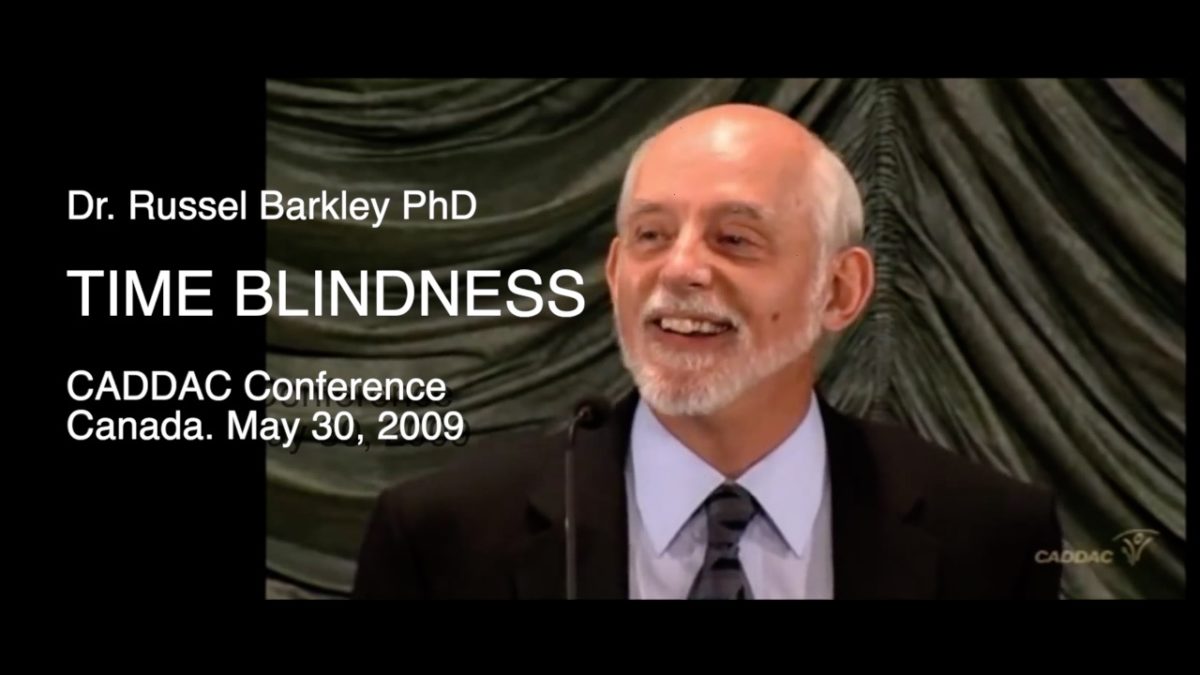
    One of the biggest struggles we face with ADHD—perhaps the struggle—is time blindness. Nothing feels more important than what we’re doing right now. Because of that, planning ahead or organizing our lives around future goals often feels nearly impossible.

    In the following clip, Dr. Russell A. Barkley explains this concept with clarity and humor. He even summarizes ADHD in a single phrase: “ADHD is time blindness.”


    ADHD and Time Blindness: Living in the Now

    Dr. Barkley defines time blindness as a kind of nearsightedness to the future. In a story that’s as funny as it is revealing, he describes how people with ADHD often get pulled along by the moment—no matter what their plans were.

    He also explains how the frontal lobe helps us organize our behavior over time, and how ADHD disrupts that process.

    “People with ADHD cannot deal with time, and that includes looking back to look ahead—to get ready for what’s coming at you. (…) The now is more compelling than the information you’re holding in mind.”
    —Dr. Russell A. Barkley, Ph.D.


    For Parents of Children With ADHD

    Dr. Barkley reminds parents that ADHD isn’t about a lack of knowledge or intelligence—it’s about difficulty using what you already know.

    “ADHD is a disorder of doing what you know. It is not a disorder of knowing what to do. (…) So you can get the smartest person on this planet, and you’re still gonna do some pretty stupid things. Because it’s not what you know—it’s doing it.”
    —Dr. Russell A. Barkley, Ph.D.


    If you’ve ever wondered why ADHD makes it so hard to follow through—even when you want to—this short talk will make a lot of sense. I hope you enjoy it!

  • “Those Cheerful ADHDers Achievers…” Ugh, Right?

    “Those Cheerful ADHDers Achievers…” Ugh, Right?

    Happy as clam! That’s how I was when I wrote that “having ADHD saved me from a lifetime of Trauma,” after having received my diagnosed. 

    But I was in a bubble… I had never followed the hashtag ADHD. I had never seen how much so many neurodivergents (especially recently diagnosed) were struggling and feeling, “All that time lost…”

    One day I came across a tweet which read: 

    “GPs / Psychiatrists…PLEASE stop telling patients that it would have been impossible for them to have gotten a degree if they had undiagnosed ADHD. It could not be any further from the truth.”@NDaoshea, June 10, 2020

    And I thought, “Yes!” But as I was scrolling down throughout the thread, I read:

    “Fair enough, but please can we remember that it is very difficult for people whose ADHD did prevent them from completing a degree to read this. The rhetoric of success can really diminish what they went through.”@AlisonHoneyBone, June 10, 2020

    And I thought, “Oops.”

    So I got to thinking, do you feel this way? Because I might be able to help you feel better…

    My Academic Resume It’s Far From My Life’s Resume

    If you read my resume, you’ll probably think, “Oh, she is super motivated because she did a lot.” But the truth is that paid a high price for it, almost with my life

    AND if you’re thinking, “But Laly, still! You got all those degrees!” I’ll ask you to please give me the chance to explain

    When the time to choose a University arrived, I knew I wanted to become an author (slash artist). During primary school, my literature teacher wrote a note on a short story I had written, telling me, “This is how writers begin.” 

    I have it framed; my mother sees the dust in the frame. I went to Law School because my parents gave me no other choice.

    Actually, here is funny story: when I had to choose a career (at 17) I signed up at two community colleges: Law School and Med School. That’s how confused I was.
    So in the morning of the first day of class, I sat down in my bed for half an hour or so and considered: “Which one should I go to? I’d like to be a pathologist (to discover mysteries and the human body doing autopsies)… but my godmother is a Lawyer so she’ll make it easier for me. 
    Law School it is!”
     
    I shit you not.

    I attended one year and I couldn’t take it anymore. So, my parents gave me one year of grace and I signed up for Drama School. The dean one day whispered to me, sitting on a small stool in a dark room during an improv class: “Don’t ever quit; you’re a natural.” 

    So I rushed to tell my parents the great news! … and they went like, “We’ll pay for you to go to a private Law School; do it and then you can do what you want. You are young.”

    I Hit Rock Bottom, Hard and Multiple Times

    After that, my life started to crumble down. And I’d say I lost twenty years before getting the chance to do what I wanted. 

    Not pursuing my dream, not being happy – while carrying a backpack filled with traumas – lead me to doing drugs, almost becoming an alcoholic and to a ten-year abusive relationship (plus forty pounds of fat). 

    But I choose to not say it… 

    am grateful for the knowledge I gained, and proud for those degrees. However, do you know what I’m most grateful for and proud of? “Having made it this far alive, with the chance and the will to start over.”

    I did try to kill myself once… almost twice… (without counting an “Oops, I didn’t mean it” near death experience)

    Growing up with an undiagnosed or untreated ADHD, or without the proper guidance to help us thrive, is a torture. It’s painfully frustrating. It eats our soul. 

    Hence, my biggest achievement is that I am still here. 

    Isn’t it yours too?

    What Is Success Anyway? My Life Is Far From Being Easy

    Success… It’s such a tricky little word… For some is money, a college degree. For others is raising happy children. If success is one of these things to you, go get them, now

    Holding a grouch is going to do for you only one thing: hold you back. Do you want that, after all the time you feel you’ve lost?


    Tough love? Yes. Doing what I love (this blog) is no walk in the park. Make no mistake. I am not cheerful all day because “I’m finally doing it!” Hell to the no. This puts everything my brain doesn’t like over my desktop, and says, “Just do it, dopamine or not.”

    I am planning and scheduling, when I’m time-blind. Surrendering to perfectionism, sometimes gives me blurred vision for hours after having published a post. I have the strict routine of cloister nun from 3.15AM to 8PM. This is far from being easy.

    And in case you missed it, it is my brain the one saying, “Just do it, dopamine or not.” Because a clear goal in our pre frontal cortex is like getting help when we’re a single parent of seven and the CEO of Google. Having a purpose is everything; I’ll say it until either you get tired of me or join the Hummingbirds Academy.

    Time, especially for us with ADHD, goes by in the blink of an eye. There is no more time to loose and so much time to win.


    Isn’t that inspiring enough? Ok… My godmother was a kindergarten teacher with two children. Things got difficult in her life, so she quit… Decades later she said “enough,” and she pursued her Law Degree at sixty-two years old. And she had quite a good run. 

    She didn’t have ADHD, but her life was a nightmare and she refused – in her 60s – to continue living that way… So I’ll tell you another one: 

    My doctor told me about a patient, recently diagnosed, who had quit Med School ten years ago with only one class left. The patient started his treatment, and now there’s a new doctor in the city.

    It’s never too late. It truly isn’t. And I’ll say this one more time so you can print it in your neurons:

    “…holding a grouch is going to do for you only one thing: hold you back. Do you want that, after all the time you feel you’ve lost?”

    With ADHD, We Define What Success Is For Us

    Success is something you can define in your own terms. 

    “Today”, success could be doing the laundry or organizing one folder in your computer. Our brain needs small tasks so we can feel a quick reward. And that, in our hyper lives, is a path to success.

    If you feel you haven’t achieved anything, you are mistaken
    Because you, you made it this far. 
    You are exhausted but you keep seeking for motivation in blogs and in anything that could give you a boost of dopamine. 
    You are resilient. 
    You are not a quitter.

    Thus, congrats! I take my hat off for you! You are a survivor, and you’ve got a bunch of great ideas waiting to come alive and you know you can make it.

    So …

    What are you going to do now?

    Become a cheerful ADHDer achiever? 😏

  • What You’re Reading About ADHD Could Be Dangerous

    What You’re Reading About ADHD Could Be Dangerous

    “Where to start?” After receiving our diagnose, many of us find that doctors don’t know enough; so, we start googleling for articles, searching on YouTube for a five or ten minute video that can explain it all; we begin following the ADHD hashtag on social networks, retweeting and reposting every time we feel, “This is totally me!” We may even take a course…

    I did it all, and I learned I should have follow my doctor’s guidance sooner than I had because: not everything that’s out there is accurate and, also, it may not applies to us.  

    Thus, I thought about reflecting on what we are reading, how it can have a bad impact on us and how we can take care of ourselves.

    Learning on Our Own

    If we want to learn how to master our ADHD brain, we’d start by learning what’s happening up there; do you agree? Then, if we want to learn how an ADHD brain is different, first we’d need to know how any brain works; right? That’s how I started; digging about the parts of the brain, on recognised websites.

    I wanted to find “one” image that would give me the whole picture; instead, I found a lot of different classifications and many of those had even another take; for instance: one of those divides the brain in two or three parts according the human evolution, and it says that the “limbic” part is the oldest. Exhausted, I asked Dr. K about it and he said, “No; forget about it; it’s a theory; read this.”

    • He gave me a list of Med Journals to search for papers (which I’ll post asap in the Guide)
    • One the first books he lent me was “The Power of Neurodiversity” by Thomas Armstrong PhD; very enlightening;
    • Then I started taking classes of neuroscience with him (lucky me, this psychiatrist specialises in neuroscience and ADHD, and he is a Professor)

    And about those papers…. When I started my treatment, one of the side effects I used to have was blurred vision. One day it got so bad that I went straight to PubMed and I found that the methylphenidate could cause glaucoma in children with ADHD. I freaked out, told my doctor and started directing all my executive functions to get an appointment with an ophthalmologist.

    My doctor said, “Wait; stay calm; try quitting them if you wish until you see the ophthalmologist; still, your PTSD may be causing those side effects; try to avoid stress; remember to drink plenty of water.” And he asked, “What did you read?” And I said, “I know the study has seven subjects, but still!”

    “Seven.” Or so…, I can’t remember… But, you get the point, right?

    Taking ADHD Courses

    Recently I spent all my savings, U$S 675 (which in Argentina feels like over a hundred percent more) [1] on an ADHD course “approved by the International Coach Federation (ICF);” that seems extremely serious and trustworthy, right? Well…

    At the “Simply ADHD” course offered by ADDCA, I received a manual from which I read: “The brain takes in incredible amounts of information from our senses, the environment, our interactions, feelings, and memories.” I went nuts; how could a course that trains ADHD coaches can say this? That’s Biology 101! The brain only receives information from our senses!

    Then I read, “The mind is the essence of our being, (…) or the commander of our command center who can pause, make thoughtful decisions, and take thoughtful action. Our mind resides in and around the brain (…)” I laughed. I mentioned this “concept of the mind” (which is a psychological theory,) to Dr. K and he went like, “Don’t even…”

    Following #ADHD on Social Networks

    There are a lot of well-known Twitter accounts from ADHD advocates, saying what ADHD is; they share their struggles: they give us a great dose of motivation but also, make a lot of people believe ADHD is the same for everyone.

    We are so much alike, that when we read another neurodivergent saying the same things in the exact way we say it, we believe, “Who am I? Am I clone? Do I even have a personality?”

    You do. You do have a personality; ADHD may define a lot of your behavior, but it doesn’t make you equal to every other neurodivergent. Your upbringing, your own values, your own strength; these are the things that shape who you are at the end of the day. How you manage your ADHD shape your neurodivergent nature.

    A Humble Advice

    Living with ADHD is quite a challenge, and the discovery path we take to understand it is very difficult; we are learning about neuroscience! But above all, what we discover can hurt us, bring us down if we don’t count with the proper guidance; and this guidance, must come from our doctor.

    There are great books; Russel A. Barkley and Thomas E. Brown are, for instance, the two most recognised authors on ADHD; but, each of them have their own vision; they even have their own “list” of executive functions. Why is that? Because no one has agreed yet on which the executive functions are.

    So, here is my humble advice (besides, of course, finding a doctor who can guide you)

    • If you find what it seems to be a nice research study, pay attention to the methods they’ve used and how many patients have participated; then, search for another one and “ask your doctor.”
    • If you’re taking a course, please don’t make the mistake I made and check who’s behind that course; the people who instructed me at ADDCA are coaches (not doctors, not specialists in neuroscience, not professors).
    • Bear in mind that the research on ADHD is in diapers; question everything; double check with your doctor;
    • When you read something on social media or an online magazine: check the author’s profile; and above all, ask yourself how do you feel about it; does it apply to you? It may not.

    As I said before,

    “ADHD may define a lot of your behavior, but it doesn’t make you equal to every other neurodivergent. Your upbringing, your own values, your own strength; these are the things that shape who you are at the end of the day. How you manage your ADHD shape your neurodivergent nature.”

    I Take It Like My Horoscope

    I don’t believe in horoscopes… but I do wonder, “If the moon has influence over the tides and the human body is mostly water, it could influence us too.” For that reason, I never paid much attention to the zodiac horoscope; but the Chinese one …, something about it got me hooked.

    Twenty years ago I went to the book signing of Ludovica Squirru, a recognized Argentinian author of the Chinese horoscope; and what she said, changed my whole perspective. She said something like,

    “This is what the starts have aligned for you, but it doesn’t mean this is going to happen to you. A horoscope should be seen as a guide; if it says we’re going to lack of money on September, save for September!”

    That is how I take everything I read on ADHD. If I read my brain has a challenge when it comes to its the executive functions, I wonder, “How does this apply to me?” For example: everybody says we all have a lot of problems with our “organization skills;” but I never had an issue with it.

    … That could be thanks to the nuns in School or due to my military father who is the epitome of what an organized person is; I don’t know… but I’m the Marie Kondo of my dopamine (with a current help of that thing called “Ritalin”; I must give it a lot of credit these days.)

    It’s said that we are wired to see the good in people; so, I’d say trust no one until you corroborate they are worth your trust.

    And remember that even though you have a neurodiverse nature, you’re still unique; wonderfully unique.

    Notes

    [1] A dollar in Argentina is over 150 pesos; thus, my wallet payed for that course what in the US would be over six thousand dollars.