
Tag: purpose

For an hyper neurodivergent brain, purpose is the first thing we need to find. What is our calling, what can makes truly happy. Creativity is one of our super powers! So, with a little bit of help, I am positive you’ll find your purpose and start a journey towards that horizon you’ve always wanted to reach.

  • “Those Cheerful ADHDers Achievers…” Ugh, Right?

    “Those Cheerful ADHDers Achievers…” Ugh, Right?

    Happy as clam! That’s how I was when I wrote that “having ADHD saved me from a lifetime of Trauma,” after having received my diagnosed. 

    But I was in a bubble… I had never followed the hashtag ADHD. I had never seen how much so many neurodivergents (especially recently diagnosed) were struggling and feeling, “All that time lost…”

    One day I came across a tweet which read: 

    “GPs / Psychiatrists…PLEASE stop telling patients that it would have been impossible for them to have gotten a degree if they had undiagnosed ADHD. It could not be any further from the truth.”@NDaoshea, June 10, 2020

    And I thought, “Yes!” But as I was scrolling down throughout the thread, I read:

    “Fair enough, but please can we remember that it is very difficult for people whose ADHD did prevent them from completing a degree to read this. The rhetoric of success can really diminish what they went through.”@AlisonHoneyBone, June 10, 2020

    And I thought, “Oops.”

    So I got to thinking, do you feel this way? Because I might be able to help you feel better…

    My Academic Resume It’s Far From My Life’s Resume

    If you read my resume, you’ll probably think, “Oh, she is super motivated because she did a lot.” But the truth is that paid a high price for it, almost with my life

    AND if you’re thinking, “But Laly, still! You got all those degrees!” I’ll ask you to please give me the chance to explain

    When the time to choose a University arrived, I knew I wanted to become an author (slash artist). During primary school, my literature teacher wrote a note on a short story I had written, telling me, “This is how writers begin.” 

    I have it framed; my mother sees the dust in the frame. I went to Law School because my parents gave me no other choice.

    Actually, here is funny story: when I had to choose a career (at 17) I signed up at two community colleges: Law School and Med School. That’s how confused I was.
    So in the morning of the first day of class, I sat down in my bed for half an hour or so and considered: “Which one should I go to? I’d like to be a pathologist (to discover mysteries and the human body doing autopsies)… but my godmother is a Lawyer so she’ll make it easier for me. 
    Law School it is!”
     
    I shit you not.

    I attended one year and I couldn’t take it anymore. So, my parents gave me one year of grace and I signed up for Drama School. The dean one day whispered to me, sitting on a small stool in a dark room during an improv class: “Don’t ever quit; you’re a natural.” 

    So I rushed to tell my parents the great news! … and they went like, “We’ll pay for you to go to a private Law School; do it and then you can do what you want. You are young.”

    I Hit Rock Bottom, Hard and Multiple Times

    After that, my life started to crumble down. And I’d say I lost twenty years before getting the chance to do what I wanted. 

    Not pursuing my dream, not being happy – while carrying a backpack filled with traumas – lead me to doing drugs, almost becoming an alcoholic and to a ten-year abusive relationship (plus forty pounds of fat). 

    But I choose to not say it… 

    am grateful for the knowledge I gained, and proud for those degrees. However, do you know what I’m most grateful for and proud of? “Having made it this far alive, with the chance and the will to start over.”

    I did try to kill myself once… almost twice… (without counting an “Oops, I didn’t mean it” near death experience)

    Growing up with an undiagnosed or untreated ADHD, or without the proper guidance to help us thrive, is a torture. It’s painfully frustrating. It eats our soul. 

    Hence, my biggest achievement is that I am still here. 

    Isn’t it yours too?

    What Is Success Anyway? My Life Is Far From Being Easy

    Success… It’s such a tricky little word… For some is money, a college degree. For others is raising happy children. If success is one of these things to you, go get them, now

    Holding a grouch is going to do for you only one thing: hold you back. Do you want that, after all the time you feel you’ve lost?


    Tough love? Yes. Doing what I love (this blog) is no walk in the park. Make no mistake. I am not cheerful all day because “I’m finally doing it!” Hell to the no. This puts everything my brain doesn’t like over my desktop, and says, “Just do it, dopamine or not.”

    I am planning and scheduling, when I’m time-blind. Surrendering to perfectionism, sometimes gives me blurred vision for hours after having published a post. I have the strict routine of cloister nun from 3.15AM to 8PM. This is far from being easy.

    And in case you missed it, it is my brain the one saying, “Just do it, dopamine or not.” Because a clear goal in our pre frontal cortex is like getting help when we’re a single parent of seven and the CEO of Google. Having a purpose is everything; I’ll say it until either you get tired of me or join the Hummingbirds Academy.

    Time, especially for us with ADHD, goes by in the blink of an eye. There is no more time to loose and so much time to win.


    Isn’t that inspiring enough? Ok… My godmother was a kindergarten teacher with two children. Things got difficult in her life, so she quit… Decades later she said “enough,” and she pursued her Law Degree at sixty-two years old. And she had quite a good run. 

    She didn’t have ADHD, but her life was a nightmare and she refused – in her 60s – to continue living that way… So I’ll tell you another one: 

    My doctor told me about a patient, recently diagnosed, who had quit Med School ten years ago with only one class left. The patient started his treatment, and now there’s a new doctor in the city.

    It’s never too late. It truly isn’t. And I’ll say this one more time so you can print it in your neurons:

    “…holding a grouch is going to do for you only one thing: hold you back. Do you want that, after all the time you feel you’ve lost?”

    With ADHD, We Define What Success Is For Us

    Success is something you can define in your own terms. 

    “Today”, success could be doing the laundry or organizing one folder in your computer. Our brain needs small tasks so we can feel a quick reward. And that, in our hyper lives, is a path to success.

    If you feel you haven’t achieved anything, you are mistaken
    Because you, you made it this far. 
    You are exhausted but you keep seeking for motivation in blogs and in anything that could give you a boost of dopamine. 
    You are resilient. 
    You are not a quitter.

    Thus, congrats! I take my hat off for you! You are a survivor, and you’ve got a bunch of great ideas waiting to come alive and you know you can make it.

    So …

    What are you going to do now?

    Become a cheerful ADHDer achiever? 😏

  • How to Find Our Inner Voice: The “Top-Down” and “Bottom-up” Processing

    How to Find Our Inner Voice: The “Top-Down” and “Bottom-up” Processing

    When I was a teenager, I thought I was “smart but dumb.” I couldn’t understand how despite being so intelligent I’d make such poor life choices. In the early 90s, without internet, I couldn’t google “how do I find my inner voice”. So, I’d ask friends about it, my dad’s wife, my aunts. But they didn’t help much.

    Today I know we can find our inner voice with science: by knowing what information we hold in our brains, and how our brain processes that information.

    Let’s make this fun.

    Between Two Opposite Inner Voices

    Knowing I was smart, but feeling I was so dumb, I’d think, “What’s wrong with me?” Like Indiana Jones in the final puzzle of the “Last crusade,” I used to jump from “I don’t know” to “probably yeah,” and then to “nope” and “Oops, I did it again.”

    I began asking people for advice, whenever I’d needed help to decide and avoid the “Oops, I did it again.” And they would always tell me, “Listen to your heart.” (Ugh) 

    I’d reply, “What does it mean? Give me a proper answer! Is it something I need to feel?” (And let me tell you, Roxette coming out with the “listen to your heart, when he is calling for you,” made me consider my musical choices.)

    So, that didn’t help much. 

    Whenever I’d have to make a decision, I used to have this issue:

    • Something in me was telling me, “I really want to do this!”
    • While another part of me was saying, “Mmm. better don’t do that.”

    Did I have two inner voices? If so, which one was right?

    Passion Vs. Purpose

    Let’s pretend two things1

    • one, that we can wrap up all the information our brain has in two categories: purpose and passion. 
    • and two,
      • that our “passion” is information we’ve gathered sort of naturally 
      • that our “purpose” is information we’ve worked on.

    Purpose and passion are simply names I came up with to distinguish easily what scientist say.

    Now, Those two categories are in two different parts of our brain: in the back bottom, and in the upper front. And they compete.

    “Bottom-Up” and “Top-Down” Processing

    “Bottom-up” and “Top-Down” processing, are scientific terms to explain how our brain processes information (according to most scientists)

    When we are trying to make a decision, those two parts begin chatting with each other: 

    • the “bottom-up processing” (which kicks in automatically, like “right away”) says, “Let’s do it! I really want this!” 
    • and the “top-down processing” says (hopefully), “Wait. Let me check if I can allow it.”

    Therefore, I had in fact two voices.

    Let’s break it down with a couple of examples.

    Example: The People Vs. Madonna

    I grew up in the 80s surrounded by women who’d tell me that, “Men can be bad, and cheat. Women must put up with it. It is the way it is and has been.”

    That “information” was stored in the back bottom of my brain (sort of speak) Those “teachings”, took root in my brain becoming a habit to choose bad boys. I wanted to choose a good one, but my intention wasn’t that strong.

    So, every time I’d meet a gorgeous bad boy, he’d become the project I could fix and the torture I’d have to endure. (Because I was woman, and that’s how things were)

    Then I discovered “Madonna”, and she’d tell me to “express myself”, to be strong. I wanted to follow her advice because it seemed according to my own beliefs of how a woman should live her life. 

    However, “old habits die hard”. So, even though a little voice within me started saying, “Choose the good boy,” I couldn’t answer to it.

    Needless to say, it took me a long time to erase what the women in my life had taught me and to embrace my own beliefs, my own way of living and my path to happiness.

    This is important:

    The brain grows from the back bottom to the upper front. And as we grow, we begin storing information there (sort of speak) So, our passion, that kicks in automatically, will be stronger. 
    It is our job to work on our goals and beliefs, so that they can win the fight.

    We are to take as much as we need to see where is the balance.

    Because… our “passion” may not always be bad. Cue for another example!

    Parting Vs. Saving Money

    Let’s say I’ve been working a lot so I could save money to buy a new computer, which I really need for my work. 

    But I get an invite to a super cool party, and, what’s the harm? A friend will pick me up and bring me back home. I won’t spend money “at all” and I deserve some fun!

    The party was mind-blowing, and so was the hunk my friend hooked up with. Now it’s 3am, and how do I get back home? 

    My instinct wisely says, “take a cab, it would be dangerous to walk back home.” My instinct is correct, but it collides with my goal of saving money.

    So how would I get out from that crossroad?

    By avoiding it in the first place.

    I had put a “bet” on the fact that I wouldn’t spend money. Why would I bet when I have an important goal?

    This is specially important for those of us with ADHD. We tend to not see beyond what’s happening now, what we want now.

    How Do I Find My Inner Voice

    Whenever I need to make a decision and I feel the two parts in my brain are driving me insane, I let them talk… And I wait… 

    Then, when I feel at peace with the result of that chit-chat, when I feel there is no more doubt, that is when I act.

    And if I need to make a decision “now”? Well, if I have my purpose very clear, and I know which of my instincts are correct, the time to reflect will certainly be shorter.

    So, if you think about it, that “Listen to your heart” response, wasn’t that wrong. When I feel my heartbeat is normal, when I stop feeling the doubt punching my chest, that is when I know I’ve found my inner voice.

    Footnotes

    1. These concepts have been explained based on Dr. Klijnjan’s “Bases neurobiológicas implicadas en el comportamiento” [PPT] Carrera de Posgrado en Psiquiatría ↩︎
  • How to Drive a Manual Brain

    How to Drive a Manual Brain

    Perhaps I should resume this new blog by telling you why I am specializing on ADHD coaching; but, since I left a hint on my previous post and recently someone asked me “What is an ADHD coach”, my brain took another turn.

    Thinking about an answer to that question, as I was driving the other day (I drive stick), a metaphor pop up in my head; I’d say I thought something like, “OMG; a neurotypical brain is like an automatic car and a neurodivergent brain is like a manual car; and just like you go to an instructor to learn how to drive, we go to an ADHD coach to guide us on learning about the particularities that are behind driving a “manual brain.”

    Then, I did my best to explain it.

    Quick Intro

    I’ve been driving stick since I learned how to drive, and I love it so much that when I drive a manual car I feel I’m not driving (it’s so easy that is boring!) To do so, as I’ll explain, one must learn how to use three pedals and a stick shift with seven positions, and also how to listen to the engine; the sound of the engine is what tell us what do next.

    It’s like becoming one with the car; one must be completely aware that we’re driving… and this, this makes every ride so much enrichening…

    Now, bear in mind this: a manual and an automatic car are the same (mostly). A few years ago, I got a brand-new Chevrolet with a payment plan and the dealer asked me, “Will you be taking the automatic or the manual one?” The question was simple because the difference between them were superficial (like, having a button to “roll down the window” or not ); but they both had the same horses, the same motor, Bluetooth! Therefore, the main difference relies on how to drive it.

    How to Drive a Manual Car

    Attention peeps! This is cool; in a manual car, there are:

    •  three pedals; from left to right:
      • the clutch (which you press with your left foot)
      • the brake, and the gas or accelerator (which you press with your right foot)
    • and the stick shift has different positions 
      • reverse and five velocities
      • neutral gear
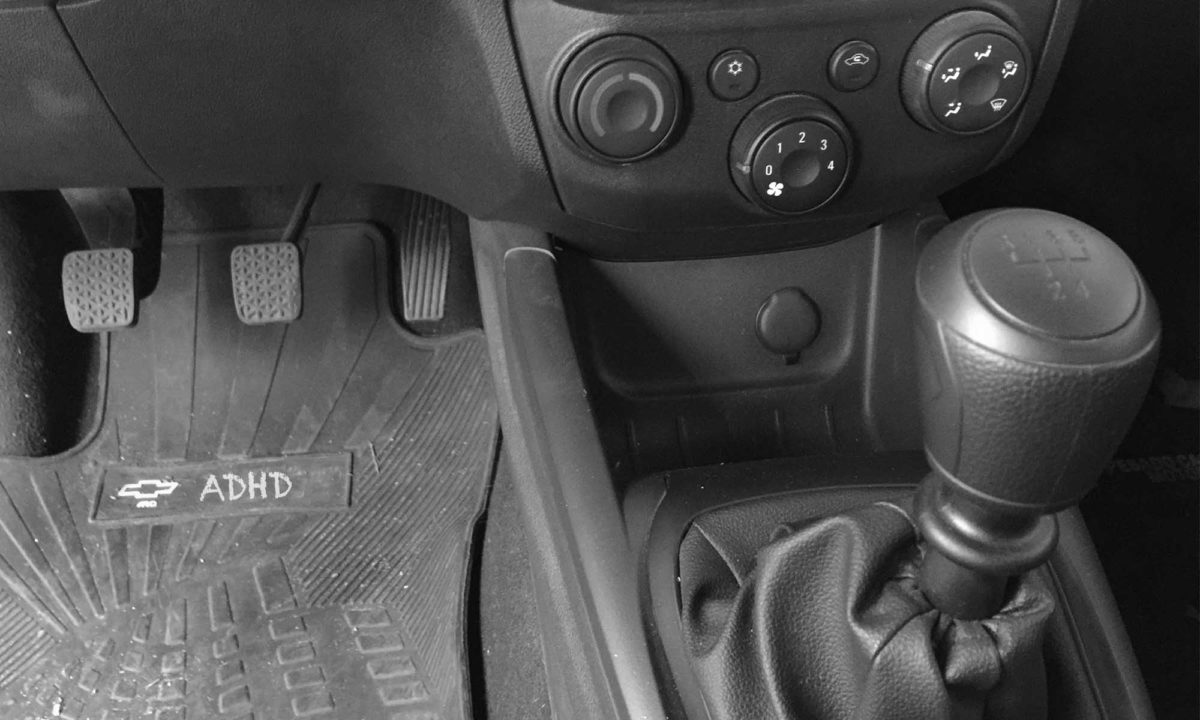
    My manual car ☺️

    And this is how you drive it:

    1. Enter the car and make sure the shift stick is on neutral;
    2. Put the keys on and start the engine; (well, duh)
    3. Press the clutch pedal and while you’re pressing it move the stick to “1”; release the clutch smoothly as you press the gas to drive for half a block or so; you’ll hear the engine asking you for more; then you:
    4. Press the clutch pedal again, move the stick to “2” and press the gas to drive for two blocks or so (always listening to the engine) And once again you,
    5. Press the clutch pedal, move the stick to “3” and – finally – press the gas and start enjoying the ride.

    Then if you:

    • want to go faster: continue pressing the clutch pedal and switching to “4” and then “5”, always listening to the engine;
    • need to stop: press the clutch pedal, move the stick to neutral and press the break.

    Bear this in mind: when you are pressing the clutch pedal to move the stick, you must release it very slowly while pressing the gas; you can’t simply lift your left foot because the car will choke. If you think about it, it’s like learning a choreography.

    It seems a lot… It is a lot; but once you get used to it, it comes naturally; what’s more difficult to learn is to listen to the engine to see when it needs more gas, and how to carefully transition from the clutch to the gas without choking the car.

    An ADHD brain, works exactly like that.

    Driving a Manual Brain

    A neurotypical brain, which is automatic, is easy to drive; you put the keys on, move the stick shift to D and press the gas to “just start driving.” A neurodivergent brain, on the other hand, is manual… and it needs more of our help.

    First, we must decide to get into the car and that is a huge deal; if where we must go is not of our interest, we won’t even bother to find the keys we’ve left “somewhere.”

    Then, we must be aware that we are driving and pay attention to the sound of the engine telling us how much power it needs; and of course, to the signs, the other cars and to those people who don’t cross the street from the corner!

    When we make a switch, we must do it smoothly and step by step; we cannot go from 1 to 3; we must change our gears step by step: 1, 2, 3, 4, full power!

    And, if an old lady wants to cross the street – and we have to release the gas, press the clutch pedal, move the shift stick to neutral and press the stop pedal – by the time grandma gets to the sidewalk, we may have forgotten where we were going to or lose interest in it; hey, we may even go back home thinking, “why did I go out in the first place? Oh… Toilette paper!”

    There is a lot more to it; but the fundamentals of driving a manual brain relies on this: 

    • having interest in going somewhere; 
    • starting with a pause;
    • being aware that we are driving (where to; what’s around us); 
    • listening to the engine to see what it needs; 
    • paying attention also to the transition process to switch gears;
    • do things one by one, following an order;
    • forgive the old lady without having a meltdown.

    So, What’s an ADHD Coach?

    It’s a neuro instructor! Is a person that will guide us to understand how this manual brain works so we can go to the moon and back because, …, yes, manual brains can also fly; and some of them can do it really fast.

    My Jalopy

    While driving a manual brain, we may feel that we’re stuck with a jalopy, with that old car our great grandparent got at an auction… and do you know what? In a way, we are; because when we get in, we see it’s full of surprises, treasures we never imagined there could be.

    In mine, I found in the trunk a map to a fantasy world where only I can go and where I can fly; under the driver’s seat, there’s a mysterious formula that makes my brain race at the speed of light and it’s hyper-awesome! The ceiling is covered with countless pictures of places, people, and things I long to visit, see and feel… And the wheel! O-M-G; the wheel has a silly smiley face over the horn, so every time I run into something that gets in my way, I smile ☺️

    A neurotypical person may wonder, “All of that?” and I’d reply, “Not even close.”

    I drove like an F1 driver for twenty years; with purpose, listening to my engine, being aware of everything around me and absorbing the knowledge from every person I’d meet and their new stories… But then, I crashed more times than I’d have expected.

    During my mid-twenties, I forgot about the cooling system and it ran out of water; and I kept pressing the gas to keep going – without listening to engine – until I broke my manual brain… Life, traumas and my own bad choices literally choked my brain until it went: “kaboom.”

    Maybe if I had known there was also a cooling system I needed to care of, I wouldn’t have failed; but then again, I wouldn’t be here telling you: “Even if you crash your brain into pieces, you can fix it.”

    Last but not least, I never lose my keys; I attached them to something big that I cherish, to something that brings me happy thoughts, so they are always at plain sight.

    … If you’d ask me, driving automatic is totally overrated.

    cark keys with a big cat keychain
    I was not lying ☺️ © neurodivergent.blog
  • How to Find a Purpose in Life

    How to Find a Purpose in Life

    Have you ever had that feeling, “I don’t know what to do with my life… I’m happy, I guess; but it feels like something is missing.” If so, this is for you.

    (more…)